
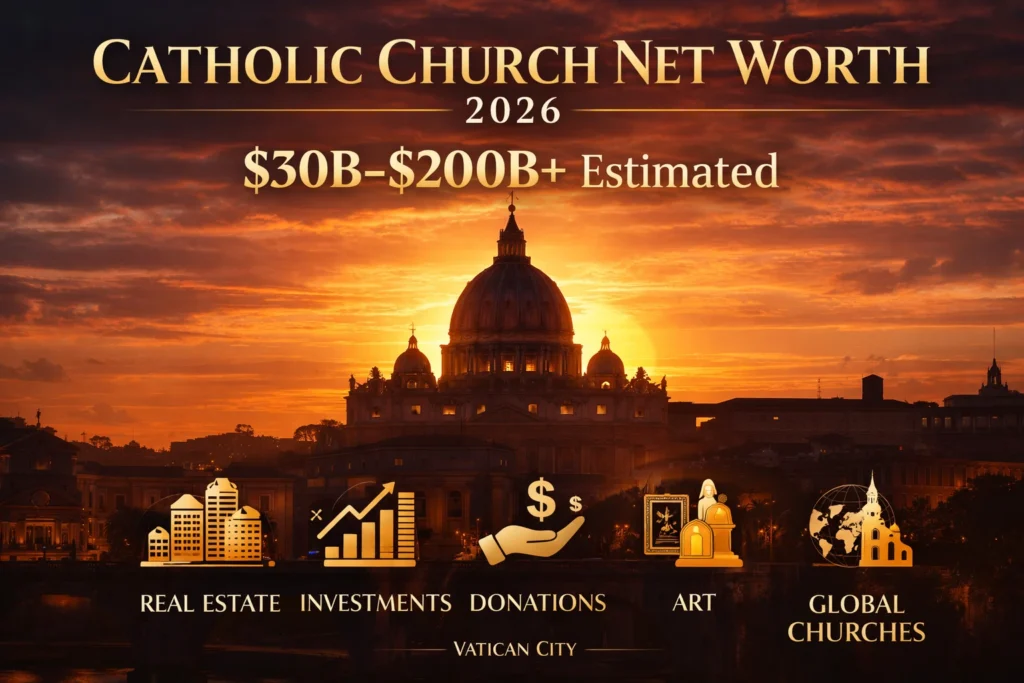
Estimated Catholic Church net worth in 2026: Between $30 billion and over $200 billion globally.
The catholic church net worth is one of the most debated and misunderstood financial topics in the world. As the largest Christian institution on earth, the Catholic Church operates across continents, owns historic properties, manages investments, and oversees charitable missions. But how much is the Church actually worth in 2026?
The answer is complex. The Catholic Church is not a single corporation—it’s a global religious institution composed of dioceses, religious orders, and the sovereign state of the Vatican. Its wealth includes real estate, art, financial investments, educational institutions, hospitals, and donations. In this in-depth financial breakdown, we analyze realistic estimates, income streams, assets, and future projections.
Disclaimer: Net worth figures are estimates based on publicly available data and may vary.
Bio Data Table
| Field | Details |
|---|---|
| Full Name | The Holy Catholic Church |
| Date of Birth | Traditionally traced to 1st Century AD |
| Age (as of 2026) | ~2,000 years |
| Place of Birth | Roman Province of Judea |
| Nationality | Global / Vatican-based |
| Height | N/A |
| Weight | N/A |
| Health Conditions | N/A (Institution) |
| Religion | Christianity (Roman Catholic) |
| Education | Operates global universities & seminaries |
| Sports | Sponsors youth & community programs |
| Zodiac Sign | N/A |
| Marriage / Relationship Status | N/A |
| Children | 1.3+ billion baptized members worldwide |
| Net Worth | Estimated $30B – $200B+ (global assets) |
| Social Media Accounts | Vatican News, Holy See official channels |
| Still Alive | Yes |
| Famous For | Largest Christian denomination globally |
Who Is The Catholic Church? Background & Early Life
The Catholic Church is the world’s largest Christian denomination, with more than 1.3 billion followers. Headquartered in Vatican City, it is led by the Pope and governed through the Holy See.
The Church traces its origins to Jesus Christ and the Apostles in the 1st century. Over two millennia, it evolved into a global religious, cultural, and political force. It operates:
- Over 220,000 parishes worldwide
- Thousands of schools and universities
- Major hospitals and charitable networks
- Historic cathedrals and heritage sites
Financially, it is decentralized. Each diocese and religious order manages its own assets, while the Vatican oversees central administration and investments.
Net Worth Overview (2026 Estimate)
Catholic Church Net Worth in 2026
Estimating the total wealth of the Catholic Church depends on scope:
- Vatican City & Holy See Assets Only:
Estimated $10–$15 billion. - Global Dioceses, Parishes, Schools, Hospitals:
Likely exceeds $30–$50 billion in real estate and liquid assets. - Including Art, Land, and Cultural Heritage:
Some estimates exceed $200 billion, though much of this is non-liquid and not for sale.
The Vatican’s financial body, APSA (Administration of the Patrimony of the Apostolic See), manages:
- Investment portfolios
- Rental properties in Rome
- International securities
- Banking operations via the Vatican Bank (IOR)
While headlines often exaggerate the Church’s “fortune,” a large portion of its wealth consists of operational assets rather than profit-generating holdings.
Net Worth Growth Timeline
Before Fame (1st–10th Century)
In early Christianity, the Church had minimal material wealth. Donations from believers supported clergy and community needs.
Breakthrough Phase (Medieval Period)
During the Middle Ages, the Church accumulated significant land through:
- Donations from monarchs
- Tithes
- Feudal land grants
By the 15th century, it was one of Europe’s largest landowners.
Peak / Recent Years (20th–21st Century)
Modern wealth stems from:
- Real estate holdings
- Financial investments
- Educational institutions
- Healthcare systems
Since the 2008 financial crisis, the Vatican increased transparency and restructured its financial governance. Under recent papal reforms, efforts have focused on accountability and cost reduction.
Main Sources of Income
Core Profession Income
The Church’s primary income streams include:
- Weekly donations (tithes and offerings)
- Mass collections
- Sacramental fees (weddings, baptisms)
- Diocesan contributions
In countries like the U.S., Catholic dioceses collectively generate billions annually through donations.
Tours / Salary / Business Revenue
Tourism is a significant contributor, especially in Vatican City.
The Vatican Museums attract millions annually, generating substantial ticket revenue. These funds support maintenance and Vatican operations.
Brand Endorsements & Sponsorships
Unlike celebrities, the Church does not engage in commercial endorsements. However, partnerships with publishers and media networks generate:
- Book sales
- Religious publications
- Broadcasting revenue
Merchandise & Licensing
Revenue streams include:
- Religious books
- Rosaries and devotional items
- Licensed Vatican stamps and coins
Though modest compared to corporate merchandise, these contribute steady income.
Business Strategy Behind the Wealth
The Church’s financial model relies on:
- Diversification: Real estate, equities, bonds, and cultural property.
- Long-Term Preservation: Assets are rarely liquidated.
- Institutional Stability: Endowments fund operations and missions.
- Global Decentralization: Financial risk is spread across dioceses.
Unlike private corporations, profit maximization is not the goal. Sustainability and mission funding are primary objectives.
Awards & Achievements and Financial Impact
While not a commercial entity, the Church’s global influence affects:
- Cultural heritage funding
- Government partnerships
- International diplomacy
Recognition of Vatican sites as UNESCO heritage properties enhances tourism revenue.
Assets & Lifestyle
Real Estate
The Church owns:
- Churches and cathedrals worldwide
- Schools and universities
- Hospitals
- Residential properties
In Rome alone, the Vatican owns significant rental properties.
Cars & Luxury
Institutionally, luxury spending is limited. However, the Church maintains official vehicles for diplomatic purposes.
Fashion / Investments
The Vatican invests in:
- Bonds
- International equities
- Real estate portfolios
Historically, some investments sparked controversy, leading to reforms in financial oversight.
Net Worth Comparison (Peers / Industry)
Compared to other global religious institutions:
- The Catholic Church is the largest in terms of followers and assets.
- Major Protestant denominations in the U.S. hold billions in combined assets.
- Some mega-churches operate multimillion-dollar campuses, but none match the Catholic Church’s global footprint.
However, unlike corporations, Church wealth is distributed and often tied to public service institutions.
Controversies, Challenges & Financial Risks
The Catholic Church has faced:
- Clergy abuse settlement payouts (billions in some countries)
- Investment scandals
- Declining attendance in Western nations
Legal settlements in the U.S. and Europe have significantly impacted diocesan finances.
Economic risks include:
- Reduced donations
- Property maintenance costs
- Inflation affecting operational expenses
Philanthropy & Social Impact
The Catholic Church runs one of the world’s largest charitable networks:
- Disaster relief programs
- Food distribution
- Healthcare missions
- Refugee assistance
Organizations like Caritas Internationalis operate globally, funded largely through Church resources and donations.
How The Catholic Church Makes Money Outside Core Profession
Beyond donations:
- Investment returns
- Rental income from Vatican properties
- Museum tourism
- Educational tuition
- Healthcare service revenue
These income streams help maintain financial stability.
Future Net Worth Projection
By 2030, experts anticipate:
- Stabilized finances through reform
- Continued tourism revenue growth
- Increasing transparency
However, declining church attendance in Europe and North America may affect long-term donation trends.
Projected 2030 Estimate: $35B–$220B (depending on valuation model)
FAQs
1. What is the Catholic Church net worth in 2026?
Estimates range from $30 billion to over $200 billion globally, depending on asset inclusion.
2. Is the Vatican richer than major corporations?
No. While wealthy in assets, it does not rival trillion-dollar corporations in liquid capital.
3. Does the Pope control all Church wealth?
No. Wealth is decentralized among dioceses worldwide.
4. How does the Vatican earn money?
Through tourism, investments, donations, and property income.
5. Is Church art included in net worth?
Some estimates include priceless art, but most is non-liquid and culturally protected.
6. Does the Church pay taxes?
In many countries, religious institutions receive tax exemptions.
Conclusion
The catholic church net worth in 2026 reflects two millennia of history, global expansion, and institutional preservation. While headlines often exaggerate its fortune, much of the Church’s wealth exists in non-liquid assets like real estate, art, and operational institutions.
Financial reforms, transparency efforts, and global diversification continue shaping its economic future. As one of the most influential religious institutions in history, its wealth supports not just religious activities but also education, healthcare, and humanitarian aid worldwide.
Net worth figures are estimates based on publicly available data and may vary.
Read More Related Articles:
- Misha Ezratti Net Worth: Shocking Wealth Revealed In 2026
- Karan Aujla Net Worth: Earnings & Financial Power In 2026
- Billie Eilish Net Worth: Income Streams & Total Value In 2026

Evan Carter is a writer at worthflux.com who explores net worth, earnings, and career trajectories. He dives deep into financial data to reveal the story behind the numbers. Evan’s approach is analytical yet approachable, making complex wealth patterns easy to understand. He aims to provide readers with clear insights into how financial success is built and maintained.